

Dark Factories: Autonomy, Intelligence, and the Reinvention of Manufacturing
For decades, manufacturing excellence has been defined by efficiency, scale, and incremental automation. Today, a new paradigm is emerging, one that moves beyond automation toward true autonomy. The concept of the Dark Factory represents this shift.
A Dark Factory is not a plant filled with robots. It is a manufacturing system capable of operating autonomously for extended periods with minimal or no human presence on the shop floor. Enabled by end-to-end digital integration and self-optimizing, data-driven decision-making, it delivers predictable, repeatable, and resilient operations.
But the path to autonomy is gradual. It is a technological, organizational, and human journey.
Beyond Automation: What a Dark Factory Really Means
Industrial robots, automated inspection, and lights-out equipment have existed for years. Yet automation alone does not create autonomy.
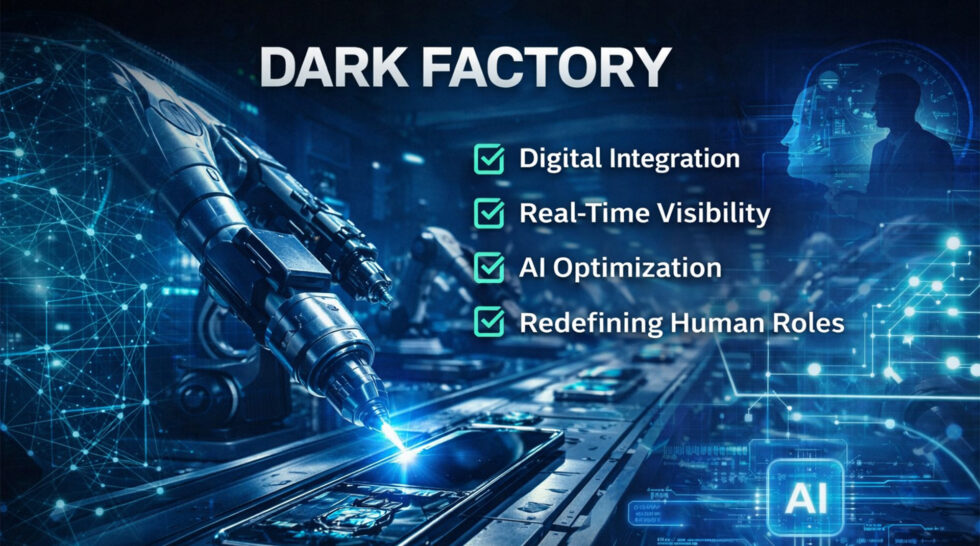
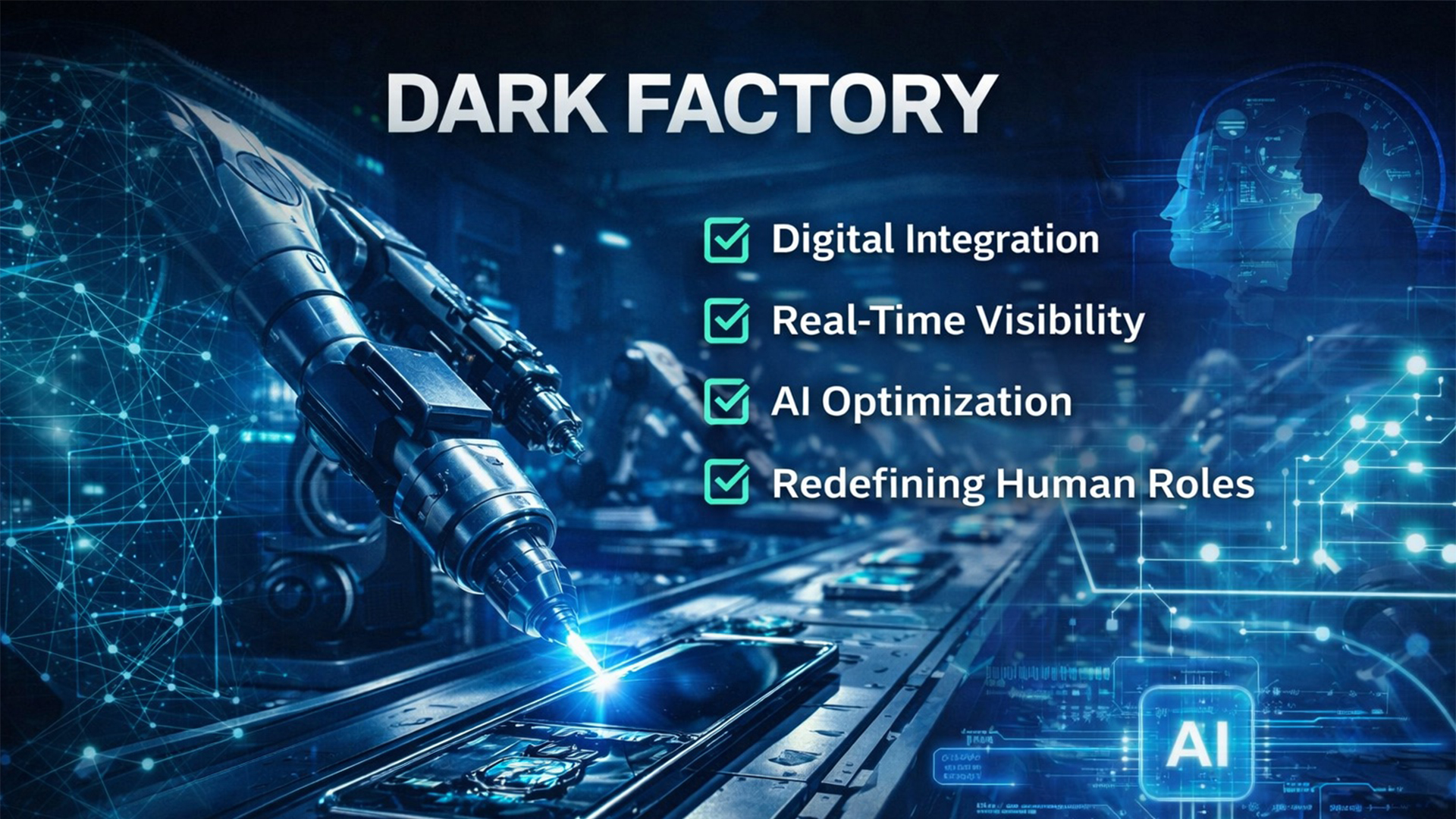
A Dark Factory distinguishes itself through three core characteristics:
- End-to-end digital integration
- Real-time visibility across machines and processes
- Self-optimizing intelligence powered by AI
In traditional automation, machines execute predefined rules. In an autonomous environment, systems learn, predict, and adapt before acting. The factory transitions from reactive control to anticipatory orchestration.
Removing lights from the ceiling without embedding intelligence into the production ecosystem will fail.
The Five Core Pillars of the Dark Factory Journey
True autonomy emerges only when five foundational pillars work in unison.
1. Physical Automation: The Foundation
Every journey begins with mechanized execution:
- Industrial robots
- Autonomous material handling
- Automated inspection and packaging
- Equipment capable of operating without constant human supervision
However, this is merely the starting point. Physical automation is necessary, but not differentiating. Many factories have automated cells; few have autonomous systems.
2. The Digital Nervous System: Real-Time Visibility Everywhere
Autonomy is impossible without visibility.
A Dark Factory requires:
- IIoT sensors distributed across assets
- Real-time machine and process data
- Integration across MES, SCADA, and ERP systems
This creates a digital nervous system where data flows continuously, synchronizing the physical and digital layers of the factory.
Without real-time visibility, autonomy collapses. With it, decision-making can shift from human operators to intelligent systems.
3. Industrial AI & Analytics: From Rules to Intelligence
This is where Dark Factories are truly born.
Traditional automation follows rules. Autonomous systems leverage AI to:
- Perform predictive maintenance
- Adapt process parameters dynamically
- Conduct AI-based quality inspection
- Optimize production scheduling based on demand signals
Instead of responding to failures, the factory anticipates them. Instead of fixed process windows, parameters self-adjust in response to real-time conditions.
The shift is subtle but transformative: from rule-based automation to AI-driven decision-making.
4. Digital Twins & Simulation: Learning Before Acting
One of the most powerful enablers of autonomy is simulation.
Digital twins — virtual replicas of machines, lines, or entire plants — allow:
- Scenario testing without stopping production
- Continuous optimization loops
- Performance forecasting under changing conditions
In this environment, the factory learns before it acts. Strategies can be validated virtually, reducing risk and accelerating improvement cycles.
The result is a closed-loop system where physical execution and digital intelligence continuously reinforce each other.
5. Autonomous Governance: Intelligence with Control
Autonomy without governance is fragile.
The final pillar ensures that autonomy is safe, trusted, and resilient:
- Exception-based human intervention
- Cybersecurity-by-design
- Strong data governance
- Built-in safety mechanisms without constant supervision
As factories become hyper-connected, cyber risk expands. Resilience becomes critical. A single failure in a fully autonomous system can halt entire lines.
Therefore, governance is not an add-on — it is a structural requirement.
What Still Stands in the Way?
Despite its promise, the Dark Factory remains more aspiration than widespread reality. Most plants today operate in hybrid or “lights-dimmed” models rather than fully dark environments.
The obstacles are significant.
Economic & Technical Barriers
The transformation demands substantial upfront CAPEX as investment in robotics systems, AI platforms, integration and retrofits and advanced sensing infrastructure.
Orchestrating robotics, IIoT, AI, MES, and enterprise systems into a coherent architecture is complex. Reliability becomes non-negotiable; 24/7 autonomy requires robust predictive maintenance and system redundancy where the margin for error narrows dramatically.
Operational & Cybersecurity Risks
As connectivity increases, so does vulnerability.
Highly connected plants widen the cyber attack surface. AI systems are only as strong as the quality of the data that feeds them. Poor data governance or model drift can degrade quality and throughput and resilience becomes a defining capability. Autonomous lines must recover gracefully from disruptions without cascading failures.
Human & Societal Considerations
Perhaps the most debated concern is workforce disruption.
Automation inevitably displaces certain tasks. Cultural resistance can slow adoption and regulatory frameworks around safety, liability, and AI governance are still evolving.
But framing Dark Factories as “job elimination” misses the larger shift.
The Human Question: Replacement or Reinvention?
Dark Factories do not eliminate humans. They eliminate human dependency inside repetitive loops. The human role is not removed it is repositioned as humans move from execution to architecture.
In an autonomous manufacturing model:
- Operators become system designers
- Manual inspectors become AI trainers
- Firefighters become strategic optimizers
- Presence-based work becomes outcome-based contribution
Instead of adjusting machine parameters on the line, engineers design the algorithms that adjust them. Instead of visually inspecting defects, specialists refine the models that detect them automatically.
This does not reduce the human value, it elevates it with added-value tasks. This requires a cognitive evolution that shifts from human intelligence operational control to strategic oversight.
Looking Ahead
As global competition intensifies and supply chains demand resilience, autonomy will become less optional and more strategic.The factories that thrive will be those with the most integrated intelligence: systems capable of sensing, learning, simulating, and acting with minimal friction.
It’s a nice paradox: Dark Factories are all about clarity : clarity of data, clarity of decision-making, and clarity of roles in a human–machine partnership that redefines industrial performance.
Ready to build your automation journey? Contact us.
